Huệ Trí: Dâng lục cúng và dâng hoa trong GĐPTVN: Truyền thống, giới hạn và trách nhiệm định chế
 Sen Trắng Hoa Kỳ
Bài viết này khởi đi từ những ghi nhận trong sinh hoạt Gia Đình Phật Tử tại Hoa Kỳ thời gian gần đây, khi một số hình thức nghi lễ được vận dụng để đáp ứng nhu cầu tu học, tưởng niệm và phụng sự trong hoàn cảnh mới. Theo sự biến thiên của thời gian và môi trường hoạt động, những vấn đề chưa từng được đặt ra, hoặc chưa được minh định đầy đủ, dần trở thành mối quan tâm chung, cần được cùng nhau suy xét trên tinh thần trách nhiệm đối với tổ chức và các thế hệ tiếp nối.
Từ nhân duyên ấy, việc bàn về Dâng Lục Cúng và Dâng Hoa hướng đến sự tìm hiểu nguồn gốc, nhận diện ý nghĩa và cân nhắc tính thích hợp của từng hình thức trong đời sống giáo dục GĐPT. Mỗi thực hành đều cần được lắng nghe trong hoàn cảnh hình thành và vận dụng của nó; mỗi đề nghị cũng cần được đối chiếu với mục đích giáo dục, nền nếp tổ chức và nhu cầu thực tế. Qua sự trao đổi cẩn trọng, chân thành ấy, chúng ta có thể cùng làm sáng tỏ những điều cần gìn giữ, những điểm cần bổ sung và những nội dung cần được minh định trong Nội Lệ Nghi Lễ, góp thêm phần hiểu biết và kinh nghiệm của hôm nay vào di sản truyền thống chung.
Bấy giờ, một nghi thức có nguồn gốc lâu đời chưa vì thế mà thích hợp với mọi hoàn cảnh; một hình thức giản dị cũng không vì ít lễ phẩm mà kém phần thành kính. Bàn về Dâng Lục Cúng trong sinh hoạt Gia Đình Phật Tử, điều cần xác lập trước hết là khả năng phân biệt: giữa truyền thống Phật giáo và phương pháp giáo dục GĐPT; giữa tham dự nghi lễ của tự viện và thiết lập nghi lễ của tổ chức; giữa một sự vận dụng có hướng dẫn và một sự thay đổi được mặc nhiên công nhận qua nhiều lần thực hiện.
Nhận định thích đáng là: có thể thực hiện Lục Cúng trong những hoàn cảnh phù hợp; không nên tự ý phổ biến thành nghi thức thường lệ hoặc thay thế Dâng Hoa. Nếu áp dụng chính thức, cần có căn cứ và hướng dẫn trong Nội Lệ Nghi Lễ của hệ thống tổ chức liên quan. Đây là đề nghị về nguyên tắc tổ chức, không phải lời phê phán đối với một đơn vị hay một buổi lễ cụ thể.
Trước hết, cần hiểu đúng chữ “Lục Cúng”. Trong truyền thống Phật giáo Việt Nam, đặc biệt ở Huế, hình thức quen thuộc là dâng sáu phẩm vật: hương, hoa, đăng, trà, quả, thực. Tuy nhiên, sáu lễ phẩm ấy, nghi thức dâng cúng và vũ khúc Lục Cúng Hoa Đăng không hoàn toàn đồng nhất. Một bên là nội dung cúng dường; một bên là trình tự hành lễ; một bên còn bao gồm hệ thống âm nhạc, động tác và đội hình được truyền thừa, phát triển trong những môi trường lịch sử cụ thể.
Tư liệu giới thiệu di sản Huế ghi nhận Lục Cúng Hoa Đăng có nền tảng từ nghi lễ Phật giáo, rồi được đưa vào cung đình và dàn dựng dưới triều Minh Mạng. Vì vậy, quy toàn bộ nghi thức này về nguồn gốc cung đình là thiếu chính xác; ngược lại, xem mọi động tác và cách trình diễn hiện nay đều nguyên vẹn từ thời Phật cũng vượt quá chứng cứ. Nguồn gốc của việc cúng dường trong Phật giáo phải được phân biệt với lịch sử hình thành một vũ nghi cụ thể tại Việt Nam.
Giá trị của Lục Cúng nằm ở chỗ phẩm vật, lời tán và thân hành cùng hướng người thực hiện đến sự cung kính, nhiếp tâm và phát nguyện. Nhưng giá trị ấy không tự động phát sinh từ số lượng lễ phẩm. Nếu người dâng chỉ nhớ đường đi mà không hiểu ý nghĩa, nếu người dự chỉ thấy một tiết mục đẹp mà không được dẫn vào tâm cúng dường, thì phần hình thức có thể hoàn tất trong khi mục đích giáo hóa vẫn còn bỏ ngỏ.
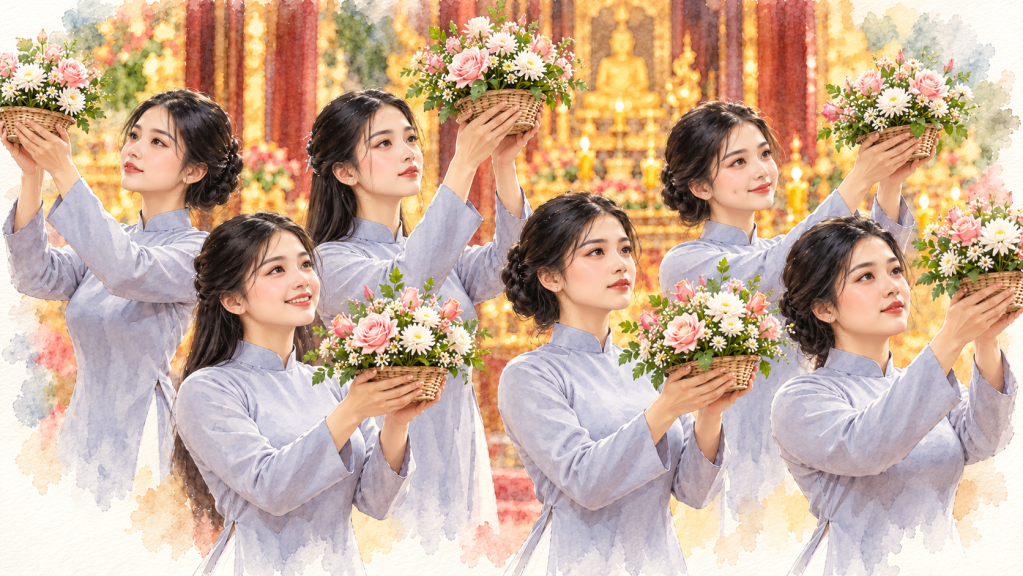
Dâng Hoa trong GĐPT cũng cần được nhìn nhận với sự phân biệt tương tự. Dâng hoa cúng Phật, dâng hoa cúng dường chư Tăng và dâng hoa cung nghinh hoặc chúc mừng không có cùng đối tượng và ý nghĩa. Trang nhà GĐPT Việt Nam từng giới thiệu nghi thức Dâng Hoa cung nghinh, chúc mừng hàng giáo phẩm khi cung an chức sự, đồng thời phân biệt hình thức ngắn gọn ấy với Dâng Cúng và Dâng Lục Cúng. Không nên lấy một tên gọi chung để xóa nhòa những khác biệt này.
Đối với một tổ chức giáo dục thanh thiếu đồng niên, sự giản dị có giá trị sư phạm rõ rệt: đoàn sinh dễ hiểu, dễ tham gia, dễ thực hành trong chánh niệm; đơn vị ít nhân lực vẫn có thể tổ chức chu đáo. Một đóa hoa được dâng bằng sự hiểu biết có thể trở thành bài học về lòng biết ơn, vẻ đẹp thanh khiết và tính vô thường. Điều đáng gìn giữ nơi Dâng Hoa chính là khả năng đưa ý nghĩa đạo vào một hành vi vừa sức tuổi trẻ.
Tuy nhiên, không thể từ đó khẳng định GĐPT chỉ có Dâng Hoa và chưa từng có căn cứ văn bản cho Lục Cúng. Trong văn kiện của Tiểu ban Tu chỉnh Nghi lễ công bố năm 2012 trên trang GĐPT Việt Nam, phần Hiệp kỵ đã ghi Dâng Lục Cúng Dường trong chương trình, kể cả phương án tổ chức một ngày. Đây là chứng cứ quan trọng, nhưng vẫn phải xác định đúng tính chất: một văn kiện tu chỉnh được công bố chưa tự nó chứng minh đã được ban hành và có hiệu lực trong mọi hệ thống GĐPT, đặc biệt tại Hoa Kỳ.
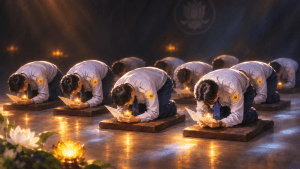
Bởi vậy, đối với việc thực hiện gần đây tại Hoa Kỳ đang đề cập, chưa thể chỉ nhìn hình ảnh rồi kết luận đúng hay sai. Cần biết buổi lễ do ai chủ trì, thuộc nghi lễ tự viện hay lễ lược nội bộ, đã được hướng dẫn theo văn bản nào và đoàn sinh tham gia với tư cách gì. Chưa có những dữ kiện ấy thì có thể bàn nguyên tắc, nhưng chưa đủ căn cứ để quy lỗi.
Có thể phân định việc nên và không nên như sau:
| Hoàn cảnh | Nhận định đề nghị |
|---|---|
| Đại lễ tại tự viện, do chư Tăng chủ trì và hướng dẫn | Có thể tham gia, với vai trò và phần việc được xác định rõ. |
| Hiệp kỵ, tưởng niệm có phần nghi lễ Phật giáo | Có thể phù hợp nếu có căn cứ áp dụng, được thống nhất với chư Tăng và cấp phụ trách tổ chức. |
| Hoạt động tìm hiểu văn hóa, âm nhạc, nghi lễ Phật giáo | Nên khuyến khích việc học; cần gọi đúng là giới thiệu, thực tập hay trình diễn, tùy tính chất. |
| Sinh hoạt hằng tuần, lễ Đội–Chúng–Đàn, lên Đoàn, phát nguyện | Không nên tự ý thêm Lục Cúng làm kéo dài hoặc thay đổi trọng tâm giáo dục. |
| Chu niên, đại hội, khai mạc trại | Không nên mặc nhiên xem Lục Cúng là thành phần cần có; phải xét chương trình và quy định áp dụng. |
| Thực hiện chủ yếu để phô diễn, gây ấn tượng hoặc chạy theo đơn vị khác | Không nên, vì động cơ ấy không đáp ứng mục đích tu học và giáo dục. |
Trong những trường hợp có thể thực hiện, điều kiện thiết yếu là người tham gia hiểu mình đang làm gì. Với đoàn sinh lớn lên tại Hoa Kỳ, phần giải thích bằng ngôn ngữ các em hiểu là một công việc giáo dục cần thiết. Các em cần biết đang dâng cúng lên ai, phẩm vật biểu đạt điều gì và động tác giúp rèn thân tâm ra sao. Việc tập dượt cũng phải phù hợp độ tuổi, thời lượng và điều kiện của đơn vị.
Đồng thời, sự hướng dẫn của chư Tăng đối với một pháp lễ và việc phê chuẩn nghi thức dùng chung trong tổ chức là hai phạm vi trách nhiệm cần phối hợp. Sự hiện diện chứng minh của chư Tăng trong một buổi lễ không nên bị suy diễn thành quyết định sửa đổi nghi lễ toàn hệ thống. Ngược lại, một quyết định hành chánh của GĐPT cũng không thay thế được sự chỉ dẫn chuyên môn đối với nghi lễ Phật giáo.
Chính ở đây, vai trò của Nội Lệ Nghi Lễ trở nên thiết yếu.
Nội lệ được ấn định để ký ức truyền thống không phụ thuộc hoàn toàn vào trí nhớ cá nhân; để đơn vị ở xa vẫn có một căn cứ chung; để người điều hành biết giới hạn trách nhiệm; và để đoàn sinh hiểu tổ chức thực hành điều gì, vì sao thực hành như thế. Nội lệ còn bảo vệ những đơn vị ít phương tiện trước áp lực phải tổ chức ngày càng cầu kỳ mới được xem là trang nghiêm.
Tài liệu hướng dẫn nghi lễ trên trang GĐPT Việt Nam nhấn mạnh việc thực hành thống nhất và tránh tự ý thêm bớt nội dung không phù hợp tinh thần buổi lễ. Nguyên tắc ấy đặt trách nhiệm giải trình lên người đề nghị thay đổi: bổ sung này phục vụ ý nghĩa nào, có cần thiết không và được chấp thuận theo thể thức nào?
Dẫu vậy, nội lệ có thể được tu chỉnh. Sự ổn định cần đi cùng khả năng tiếp nhận những nhu cầu có cơ sở. Bản Nội Quy GĐPTVN tại Hoa Kỳ được tra cứu cho thấy trách nhiệm điều hành, ban hành văn kiện và sửa đổi Nội Quy được phân định giữa các cơ quan tổ chức. Tuy nhiên, không nên lấy thủ tục sửa Nội Quy để mặc nhiên đồng nhất với thủ tục ban hành Nội Lệ Nghi Lễ; thẩm quyền cụ thể phải được đối chiếu với văn bản đang có hiệu lực.
Nếu chính thức áp dụng Lục Cúng, nội lệ hoặc phụ lục hướng dẫn cần xác định ít nhất: mục đích; những buổi lễ được thực hiện; tính chất bắt buộc hay tùy nghi; đối tượng dâng cúng; người hướng dẫn; lễ phẩm, lời tán và động tác; thời lượng; yêu cầu huấn luyện; cùng thể thức chấp thuận trường hợp đặc biệt. Cũng phải nói rõ việc dâng sáu phẩm vật giản dị có đòi hỏi toàn bộ vũ nghi Lục Cúng Hoa Đăng hay không.
Điều cần bổ sung, vì vậy, không những là một mục “Dâng Lục Cúng” trong chương trình. Đó phải là một hướng dẫn đủ rõ để người thực hiện hiểu, người phụ trách chịu trách nhiệm và các đơn vị có thể áp dụng nhất quán.
Một tổ chức giáo dục trưởng thành cần biết trân trọng di sản, lựa chọn phương tiện và giữ kỷ cương. Lục Cúng đáng được hiểu đúng trước khi được vận dụng; Dâng Hoa đáng được thực hành sâu trước khi bị xem là chưa đủ. Nghi lễ hoàn thành ý nghĩa khi sau lúc phẩm vật được đặt xuống, nơi người trẻ còn được nâng lên một điều gì: lòng kính, sự hiểu biết và ý thức sống có trách nhiệm với cộng đồng.
Phật lịch 2570 – Kissimmee, FL 22.10.2026
HUỆ TRÍ Nguyễn Gia Hải
 The sixfold offering and flower offering in GĐPTVN:
Tradition, boundaries, and institutional responsibility
This article arises from observations of recent activities within Gia Đình Phật Tử Việt Nam—the Vietnamese Buddhist Youth Association (GĐPT)—in the United States, where certain ritual forms have been adopted to meet the needs of Buddhist learning and practice, commemoration, and service in new circumstances. As time passes and the conditions in which the organization operates change, questions that had not previously arisen, or had not been fully clarified, gradually become matters of shared concern. They call for collective reflection, guided by a sense of responsibility toward the organization and succeeding generations.
It is in this spirit that the discussion of the Sixfold Offering (Dâng Lục Cúng) and the Flower Offering (Dâng Hoa) seeks to explore their origins, understand their meanings, and consider the appropriateness of each within GĐPT’s educational life. Each practice deserves to be understood in the circumstances of its formation and application; each proposal should likewise be considered in light of educational aims, established organizational practices, and practical needs. Through careful and sincere dialogue, we can clarify what should be preserved, what may need to be added, and what requires explicit provision in the Internal Regulations on Ritual and Ceremony, contributing today’s understanding and experience to our shared traditional heritage.
With this in mind, the antiquity of a ritual does not in itself make it suitable for every circumstance; nor is a simple observance less reverent because it involves fewer offerings. In discussing the Sixfold Offering within GĐPT, the first requirement is discernment: between Buddhist tradition and GĐPT’s educational methods; between participating in a temple’s religious observances and establishing the organization’s own ceremonies; and between a practice undertaken with guidance and a change that comes to be tacitly accepted through repetition.
A considered position is that the Sixfold Offering may be performed in appropriate circumstances, but should not be independently established as a routine observance or substituted for the Flower Offering. If formally adopted, it should have a clear basis and guidance within the Internal Regulations on Ritual and Ceremony of the organizational body concerned. This is a proposal concerning organizational principles, rather than a criticism of any particular unit or ceremony.
First, the term “Sixfold Offering” must be properly understood. In Vietnamese Buddhist tradition, particularly in Huế, its familiar form consists of six offerings: incense, flowers, light, tea, fruit, and food. These six offerings, the ritual of presenting them, and the ceremonial dance known as Lục Cúng Hoa Đăng are not entirely identical. The first concerns what is offered; the second, the order and manner of the observance; the third also encompasses a system of music, movements, and formations transmitted and developed within particular historical settings.
Materials introducing Huế’s cultural heritage describe Lục Cúng Hoa Đăng as having its foundation in Buddhist ritual before being introduced into the imperial court and choreographed during the reign of Emperor Minh Mạng. It is therefore inaccurate to attribute the entire observance to a court origin. Conversely, to regard every movement and present-day mode of performance as having survived unchanged from the Buddha’s time goes beyond the available evidence. The origins of offering practices in Buddhism must be distinguished from the history of a particular ceremonial dance developed in Vietnam.
The value of the Sixfold Offering lies in the way offerings, chants, and bodily actions together guide participants toward reverence, collectedness of mind, and the making of vows. That value, however, does not arise automatically from the number of offerings. If those presenting them remember only their movements without understanding their meaning, and those attending see only an attractive performance without being guided toward the spirit of offering, the outward form may be completed while its educational purpose remains unfulfilled.
The Flower Offering within GĐPT requires similar discernment. Offering flowers to the Buddha, presenting flowers as an offering to the monastic community, and presenting flowers in welcome or congratulation do not have the same recipients or meanings. The GĐPT Việt Nam website has introduced a Flower Offering observance for welcoming and congratulating senior monastics upon their ceremonial installation in office, while distinguishing that brief form from other offering rituals and the Sixfold Offering. A shared name should not obscure these differences.
For an organization dedicated to educating children and young people, simplicity has clear pedagogical value: members can readily understand, participate, and practice mindfully, while units with limited personnel can still conduct the observance with care. A flower offered with understanding can become a lesson in gratitude, purity, and impermanence. What deserves to be preserved in the Flower Offering is its capacity to convey Buddhist meaning through an action suited to young people.
Nevertheless, this does not justify asserting that GĐPT has only the Flower Offering and has never had a documentary basis for the Sixfold Offering. A document issued by the Subcommittee on the Revision of Ritual and Ceremony and published on the GĐPT Việt Nam website in 2012 includes the Sixfold Offering in the program for the collective memorial observance (Hiệp kỵ), including its one-day format. This is important evidence, but its status must be accurately understood: the publication of a revision document does not by itself establish that it has been formally promulgated and is binding across all GĐPT organizational bodies, particularly those in the United States.
Accordingly, the recent practices in the United States under discussion cannot be judged right or wrong on the basis of images alone. We need to know who presided over the ceremony, whether it belonged to a temple’s religious observances or GĐPT’s internal ceremonies, which document guided its conduct, and in what capacity the youth members participated. Without these facts, principles may be discussed, but there is insufficient basis for assigning fault.
The following distinctions may help clarify when the practice may or may not be appropriate:
| Circumstance | Proposed assessment |
|---|---|
| A major temple observance presided over and guided by monastics | GĐPT may participate, with clearly defined roles and responsibilities. |
| A collective memorial or commemorative ceremony that includes Buddhist ritual | The practice may be appropriate if there is an established basis for its use and agreement between the monastics and the responsible organizational leadership. |
| Activities exploring Buddhist culture, music, and ritual | Learning should be encouraged; the activity should be accurately identified as an introduction, a practice session, or a performance, according to its nature. |
| Weekly activities and ceremonies for youth groups, advancement to a new age division, or the taking of membership vows | The Sixfold Offering should not be added independently in ways that prolong the ceremony or shift its educational focus. |
| Anniversary celebrations, general assemblies, or camp openings | The Sixfold Offering should not automatically be treated as a required component; its inclusion must be considered in light of the program and applicable regulations. |
| Activities undertaken primarily for display, to impress, or to imitate other units | Such use is inadvisable because these motives do not serve the purposes of Buddhist learning, practice, and education. |
Where the practice is appropriate, an essential condition is that participants understand what they are doing. For youth members growing up in the United States, explanations in a language they understand are a necessary part of education. They need to know to whom the offerings are presented, what the offerings express, and how the movements contribute to cultivating body and mind. Rehearsals must also be appropriate to their ages, the time available, and the unit’s circumstances.
At the same time, monastic guidance over a religious observance and organizational approval of a ceremony for common use are two areas of responsibility that require coordination. The presence of monastics bearing witness at a ceremony should not be interpreted as a decision to revise ritual practice throughout the organization. Conversely, an administrative decision by GĐPT cannot replace specialized guidance in Buddhist ritual.
It is here that the role of the Internal Regulations on Ritual and Ceremony becomes essential.
These regulations are established so that the memory of tradition does not depend entirely on individual recollection; so that geographically distant units retain a common point of reference; so that those conducting ceremonies understand the limits of their responsibilities; and so that youth members understand what the organization practices and why. Such regulations also protect units with limited resources from the pressure to make ceremonies increasingly elaborate in order to be considered dignified.
Ritual guidance published on the GĐPT Việt Nam website emphasizes consistency in practice and cautions against independently adding or removing elements in ways that are inconsistent with the spirit of the ceremony. This principle places a responsibility on those proposing changes to explain their purpose: What meaning does the addition serve? Is it necessary? Through what procedure is it approved?
The regulations may nevertheless be revised. Stability should be accompanied by the capacity to respond to well-founded needs. The version of the GĐPTVN in the United States’ Organizational Rules consulted for this article assigns responsibilities for administration, the issuance of documents, and amendments to the Organizational Rules among the organization’s governing bodies. However, the procedure for amending the Organizational Rules should not automatically be equated with the procedure for promulgating the Internal Regulations on Ritual and Ceremony. The relevant authority must be determined by reference to the documents currently in force.
If the Sixfold Offering is formally adopted, the regulations or accompanying guidelines should specify, at a minimum: its purpose; the ceremonies in which it may be performed; whether it is mandatory or optional; the recipients of the offerings; who provides guidance; the offerings, chants, and movements; its duration; training requirements; and the procedure for approving exceptional cases. They should also clarify whether the simple presentation of six offerings requires the full ceremonial dance of Lục Cúng Hoa Đăng.
What is needed, therefore, extends beyond adding “Sixfold Offering” as an item in a program. There must be guidance sufficiently clear for participants to understand the practice, for those in charge to accept responsibility, and for units to apply it consistently.
A mature educational organization must know how to honor its heritage, choose appropriate methods, and maintain organizational discipline. The Sixfold Offering deserves to be properly understood before it is adopted; the Flower Offering deserves to be practiced with depth before it is considered insufficient. A ceremony fulfills its meaning when, after the offerings have been set down, something within the young person has been lifted: reverence, understanding, and a sense of responsibility toward the community.
Buddhist Era 2570 — Kissimmee, Florida, October 22, 2026
HUỆ TRÍ Nguyễn Gia Hải