

Huệ Trí: Bản tin Tổng hợp: Nửa thế kỷ Áo Lam — từ một cuộc trở về đến một cuộc lên đường
 Sen Trắng Hoa Kỳ
Năm mươi năm đối với một đời người là một khoảng thời gian đủ dài để nhìn lại những gì được mất, bao lần gặp gỡ và chia xa.
Đối với một tổ chức giáo dục thanh thiếu niên được mang theo từ quê hương, kinh qua biến động lịch sử để bén rễ ở một vùng đất mới rồi tiếp tục nuôi dưỡng nhiều thế hệ, thì năm mươi năm đó còn mang một ý nghĩa sâu xa hơn nhiều, đó không đơn thuần là chiều dài của thời gian mà là chiều sâu của ký ức, của công hạnh, của sự tiếp nối và của trách nhiệm đối với tương lai.
Năm 2026, tổ chức chúng ta cùng lúc đi qua hai dấu mốc đặc biệt: 75 năm danh xưng Gia Đình Phật Tử Việt Nam, 1951–2026, và 50 năm Gia Đình Phật Tử Việt Nam tại Hoa Kỳ, 1976–2026. Nếu sự kiện thứ nhất đưa chúng ta trở về với căn nguyên của một lý tưởng giáo dục đã được nhiều thế hệ gìn giữ, thì sự kiện thứ hai nhắc lại một hành trình rất riêng của người Áo Lam trên đất khách, nghĩa là hành trình đem theo một truyền thống, thích nghi với một xã hội mới và từng bước tạo dựng một cộng đồng sinh hoạt để con em Việt Nam vẫn còn một nơi được lớn lên trong tinh thần Bi – Trí – Dũng. Chính tinh thần nhớ về cội nguồn, tri ân người đi trước và nhìn lại nửa thế kỷ phụng sự nơi xứ người cũng là ý hướng được nêu bật trong các Bản Tin Kỷ niệm sẽ phát hành sắp tới.
Bấy giờ, Đại Lễ Kỷ niệm lần này sẽ khó được hiểu đầy đủ nếu chúng ta chỉ xem đây như một nghi lễ đánh dấu thời gian. Một lễ kỷ niệm thực sự có ý nghĩa khi quá khứ được đánh thức trong hiện tại và từ đó trở thành năng lượng cho tương lai. Chúng ta trở về không phải để bằng lòng với những gì đã có, càng không phải để tô đẹp một hành trình vốn đã trải qua nhiều thăng trầm, mà để nhận ra rằng sự hiện diện của GĐPTVN tại Hoa Kỳ hôm nay là kết quả của biết bao bàn tay khối óc âm thầm xây dựng, biết bao thế hệ đã trao hết tuổi trẻ của mình cho tổ chức, và cũng để tự hỏi thế hệ hôm nay sẽ trao lại điều gì cho những ai tiếp bước.
Trong tinh thần ấy, chương trình ngày Chủ Nhật, 06 tháng 9 năm 2026 được hình thành như một không gian hội ngộ rộng mở hơn là một chương trình lễ nghi thuần túy. Từ đầu giờ chiều, triển lãm, trò chơi dân gian, đố vui, thi đua thủ công lần lượt diễn ra trước khi bước vào Lễ Kỷ niệm chính thức lúc 4 giờ chiều; sau đó là chợ phiên, xổ số và chương trình văn nghệ kéo dài đến 9 giờ tối. Những sinh hoạt tưởng như rất khác nhau ấy, nhìn sâu hơn, lại cùng gặp nhau ở một điểm chính là đưa lịch sử ra khỏi những trang biên niên để lịch sử được sống lại bằng sự hiện diện và tham dự của chính những người Áo Lam hôm nay.

Một trò chơi dân gian, chẳng hạn, thoạt nhìn chỉ là một cuộc vui. Nhưng đối với những em nhỏ sinh trưởng tại Hoa Kỳ, một chiếc cầu tre, trò đá cầu, banh đũa, bịt mắt đập niêu hay tạt lon có thể là lần đầu tiên các em chạm vào một phần tuổi thơ Việt Nam mà cha mẹ và anh chị mình từng trải qua. Văn hóa trong trường hợp ấy không còn là điều được giảng giải mà trở thành một kinh nghiệm sống. “Đố Vui Để Học” cũng được tổ chức theo tinh thần như thế, cho phép người tham dự luyện tập, thử sức, chơi lại để cải thiện thành tích và tự do chuyển đổi giữa các trò chơi trong thời gian thi đấu chính thức từ 2 giờ đến 4 giờ chiều. Đằng sau niềm vui thi đua vẫn là một phương pháp giáo dục vốn rất quen thuộc với GĐPT bằng đưa việc học vào sinh hoạt và để sự trưởng thành diễn ra tự nhiên trong niềm vui tập thể.
Sân khấu văn nghệ cũng không được quan niệm như nơi dành riêng cho những người có năng khiếu biểu diễn. Đó là một không gian để các đơn vị kể câu chuyện của mình bằng nghệ thuật. Các thể loại dự thi gồm hát, múa và kịch ngắn; từ ca khúc Phật giáo, nhạc truyền thống, nhạc GĐPT đến múa truyền thống, múa hiện đại, tiểu phẩm giáo dục và sân khấu hóa truyện Phật giáo. Nội dung được khuyến khích hướng về quá trình hình thành và phát triển GĐPT, tinh thần Phật giáo, những giá trị đạo đức, nhân bản và Tình Lam. Như vậy, một bài hát hay một hoạt cảnh trong Đại Lễ không những nhằm tạo không khí vui tươi. Nó có thể trở thành một phương tiện chuyển tải ký ức và lý tưởng từ thế hệ này sang thế hệ khác. Hạn chót ghi danh văn nghệ là ngày 22 tháng 8 năm 2026, và mỗi đơn vị có thể ghi danh tối đa hai tiết mục.

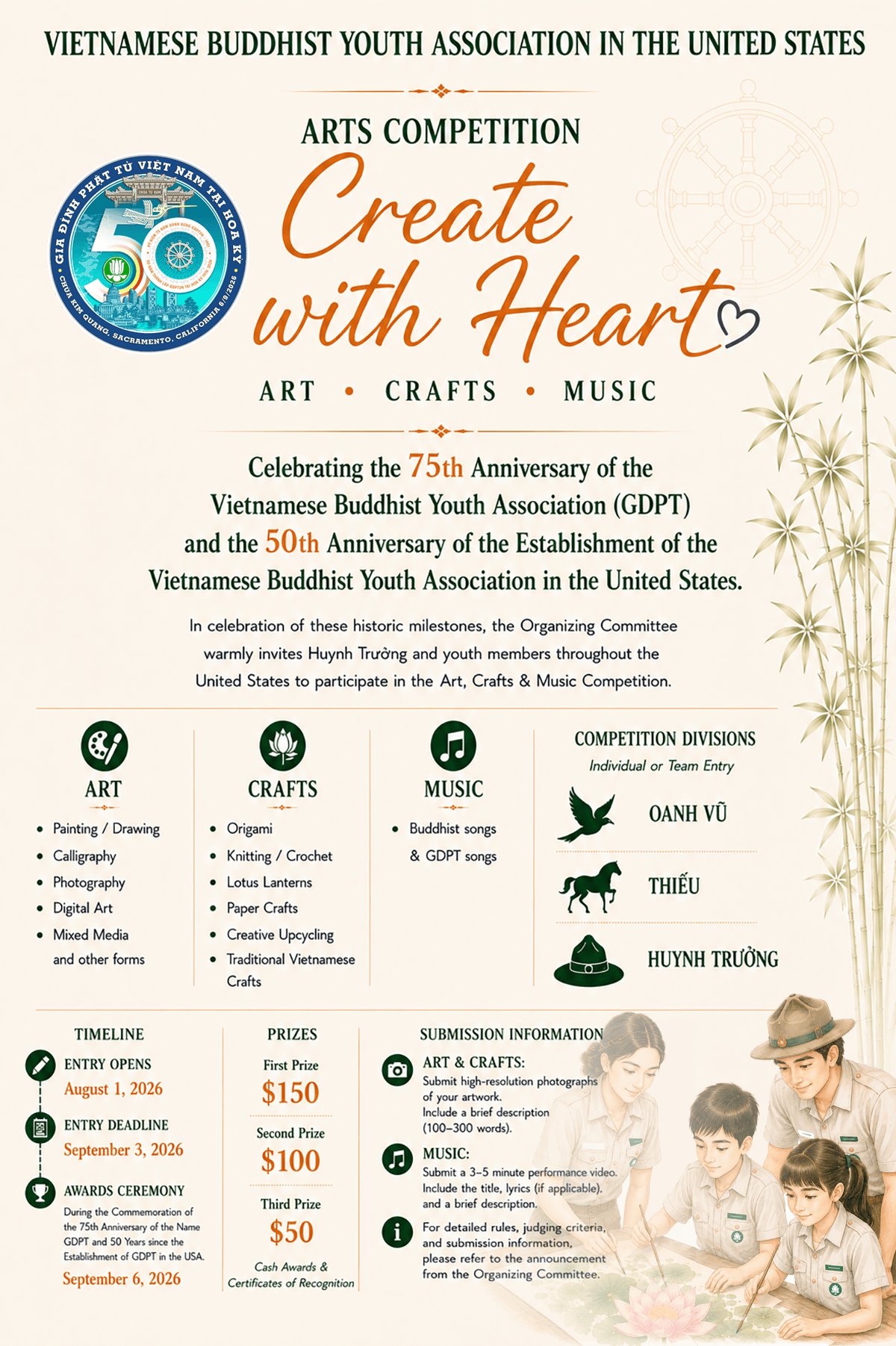
Tinh thần sáng tạo còn được mở rộng qua những sinh hoạt mỹ thuật và thủ công, nơi người tham dự được mời gọi diễn đạt lòng tri ân đối với người đi trước, suy nghĩ về hành trình năm mươi năm và gửi gắm ước vọng cho tương lai. Ý nghĩa của những sinh hoạt này nằm ở chỗ lịch sử không bị đặt sau lớp kính của một cuộc triển lãm để người hôm nay đứng ngoài quan sát. Người trẻ được mời bước vào lịch sử, chạm lấy một phần di sản ấy bằng chính đôi tay mình, diễn giải nó bằng ngôn ngữ của thế hệ mình và từ đó tạo nên một mối liên hệ sống động giữa quá khứ, hiện tại và tương lai.
Cũng bởi một tổ chức không được tạo nên chỉ từ những biến cố lớn, Ban Tổ Chức đã mời các Ban Hướng Dẫn Miền và các đơn vị mang về Đại Lễ những vật phẩm, hình ảnh sinh hoạt và dấu ấn riêng để triển lãm, trưng bày và giới thiệu với Lam viên khắp nơi. Một tấm ảnh đã phai màu, một tập san cũ, một huy hiệu, một kỷ vật trại, một thủ bút hay một vật dụng từng đi qua nhiều năm sinh hoạt có thể rất khiêm tốn về giá trị vật chất, nhưng khi được đặt bên cạnh những chứng tích của các đơn vị khác, chúng hợp thành ký ức tập thể. Lịch sử GĐPTVN tại Hoa Kỳ, suy cho cùng, không chỉ nằm trong những nghị quyết hay những cột mốc tổ chức. Lịch sử ấy còn nằm trong vô số đời sống bình dị đã gặp nhau dưới một màu áo.
Nhưng nếu Đại Lễ chỉ dừng lại ở việc nhớ lại quá khứ thì năm mươi năm vẫn chưa được thể hiện hết ý nghĩa Một tổ chức đã đi qua nửa thế kỷ cần đủ bình tâm để nhìn lại chính mình. Nhìn lại những thành tựu của người đi trước, chính là một hình thức tri ân trưởng thành hơn, nghĩa là hiểu những gì đã được trao lại, nhận diện những gì chưa hoàn tất và tự nhận lấy trách nhiệm đối với phần đường còn ở phía trước.

Chính ở điểm này, Bản Tin – Kỷ yếu 50 năm mang một ý nghĩa đặc biệt. Bản tin kỷ niệm một sự kiện thông thường có thể ghi lại diễn tiến, hình ảnh, phát biểu và cảm tưởng. Nhưng một ấn phẩm của nửa thế kỷ cần đi xa hơn chức năng lưu niệm. Nó phải trở thành một tư liệu lịch sử, một không gian suy tư và, trong mức độ có thể, một bản ghi nhận trí tuệ tập thể của nhiều thế hệ. Tiểu Ban Truyền Thông xác định Bản Tin nhằm ghi nhận hành trình thành lập, phát triển và hội nhập, đồng thời tri ân các bậc tiền bối hữu công và những thế hệ Lam viên đã gìn giữ tổ chức. Nội dung được mời gọi vì thế không giới hạn ở hồi ký hay tường thuật, mà còn bao gồm nghiên cứu, nhận định, đánh giá sinh hoạt, tư tưởng, đề nghị và định hướng phát triển.
Đây có lẽ cũng là lúc chúng ta cần mạnh dạn đặt ra những câu hỏi khó hơn. Năm mươi năm qua GĐPT tại Hoa Kỳ đã gìn giữ được những gì? Những gì vẫn chưa thực hiện được? Đâu là những ưu điểm cần tiếp tục nuôi dưỡng và đâu là những giới hạn cần được nhận diện? Khi thế hệ hình thành GĐPT sau biến cố di dân dần bước vào tuổi cao niên, thế hệ trẻ sinh trưởng tại Hoa Kỳ sẽ tiếp nhận tổ chức bằng cách nào? Tiếng Việt, văn hóa Việt, giáo dục Phật giáo, chương trình huấn luyện, truyền thông, khả năng hội nhập và sự chuyển giao trách nhiệm giữa các thế hệ sẽ được đặt ở đâu trong một xã hội đang thay đổi rất nhanh? Và quan trọng hơn, GĐPT phải chuẩn bị hôm nay như thế nào để năm mươi năm sau vẫn còn đủ sức sống để tiếp tục sứ mệnh giáo dục của mình?

Những câu hỏi ấy không thể được trả lời bởi một người, một thế hệ hay một cấp lãnh đạo. Một tổ chức tồn tại lâu dài cần biết tập hợp trí tuệ của chính cộng đồng mình. Người Huynh trưởng đã đi qua bốn mươi hay năm mươi năm sinh hoạt mang theo kinh nghiệm mà sách vở không thể thay thế. Người Huynh trưởng trẻ lại nhìn thấy những vấn đề mà thế hệ trước đôi khi khó nhận ra. Đặc biệt, tiếng nói của những đoàn sinh sinh trưởng trong môi trường văn hóa Hoa Kỳ cần được lắng nghe như tiếng nói của những người sẽ trực tiếp quyết định hình hài GĐPT trong tương lai. Bởi vậy, đóng góp một bài viết cho Kỷ yếu không nhất thiết là một hành vi văn chương. Đó có thể được hiểu như việc mỗi người đặt phần ký ức, kinh nghiệm và suy tư mình đang giữ vào kho ký ức chung của tổ chức. Hạn nhận bài hiện được ấn định vào ngày 15 tháng 8 năm 2026.
Nhìn từ toàn bộ những chuẩn bị đang diễn ra — từ sân khấu, triển lãm, trò chơi dân gian, Đố Vui, thủ công, văn nghệ đến Bản Tin Kỷ yếu — Đại Lễ đang dần hiện ra không phải như một chương trình dành cho một số người tổ chức và số đông còn lại đến tham dự. Giá trị của Đại lễ nằm chính ở sự tham gia. Một Đại Lễ năm mươi năm chỉ thực sự đầy đặn khi mỗi đơn vị mang về một phần sức sống của mình, mỗi thế hệ mang về một phần ký ức của mình, và mỗi Lam viên tìm thấy trong đó một việc mình có thể góp sức.
Vì thế, có lẽ chúng ta cũng nên thay đổi nhận thức về ngày 6 tháng 9. Đừng chỉ đến dự Đại Lễ. Hãy về Đại Lễ.
“Đến dự” là đến với một chương trình đã được người khác chuẩn bị. “Trở về” mang một ý nghĩa khác. Đó là trở về với một cộng đồng mà mình đã từng thuộc về; trở về gặp một người Anh, một người Chị, một người bạn Lam lâu ngày chưa gặp; đưa con em mình về để chúng hiểu chiếc áo đang mặc có một lịch sử dài hơn tuổi đời của chúng; và cũng là trở về để nhìn lại chính mình sau những năm tháng đã đi cùng tổ chức.
Năm mươi năm trước, những thế hệ đầu tiên trên đất Hoa Kỳ không có sẵn một cơ ngơi hoàn chỉnh để thừa hưởng. Những gì dần thành hình đã được dựng lên giữa bao giới hạn của đời sống di dân, bằng thời gian, công sức, sự nhẫn nại và niềm tin của những con người nghĩ đến một thế hệ mà lúc ấy nhiều em còn chưa ra đời. Hôm nay, chúng ta chính là một phần của thế hệ đã được thừa hưởng thành quả ấy. Sự tri ân đẹp nhất vì thế không nằm ở việc nói thật nhiều về người trước, mà ở khả năng tiếp tục làm cho những gì người trước trao lại còn có ý nghĩa đối với người sau.

Thông báo của Ban Tổ Chức đã nhấn mạnh tinh thần nhớ ơn, ghi ơn và đền ơn các bậc tiền bối hữu công; đồng thời hướng đến việc duy trì Tình Lam, phát triển tổ chức và mở một tương lai tươi sáng cho đàn em. Đó cũng chính là mạch nối sâu xa giữa hai khái niệm kỷ niệm và lên đường. Nhớ lại một hành trình không phải để đứng lại ở cuối con đường cũ. Nhớ là để biết mình từ đâu đến; hiểu mình đang đứng ở đâu; rồi cùng nhau xác định nơi cần đi tới.
Do vậy, ngày 6 tháng 9 năm 2026 có thể được xem như một cuộc hội ngộ, nhưng sâu xa hơn, đó là một cuộc trao truyền. Người đi trước trao lại ký ức. Người đang gánh vác trao nhau trách nhiệm. Người trẻ đem đến những câu hỏi mới. Các em nhỏ đem đến tương lai.
Và giữa tất cả những điều ấy, mỗi chúng ta chỉ cần mang về một điều rất giản dị đó chính là sự hiện diện của chính mình.
Bởi rồi sẽ đến một ngày, những Lam viên của năm 2076 nhìn lại cột mốc hôm nay. Điều đáng để các em nhớ không phải sân khấu năm nào lớn bao nhiêu, chương trình đông đến mức nào hay chúng ta đã tổ chức được bao nhiêu cuộc thi. Điều quan trọng hơn là giữa một thời đại nhiều biến chuyển, những người Áo Lam của năm 2026 đã biết cùng nhau trở về, đủ khiêm cung để nhìn lại mình, đủ biết ơn để nhớ người đi trước, đủ thương yêu để nắm tay người đang đồng hành và đủ viễn kiến để mở đường cho những người chưa đến.
Nửa thế kỷ đã trở thành lịch sử. Nửa thế kỷ kế tiếp, từ hôm nay, là trách nhiệm của chúng ta.
Phật lịch 2570 – Florida, 11.08.2026
HUỆ TRÍ Nguyễn Gia Hải
Theo dõi thông tin Đại Lễ Kỷ Niệm trên trang Facebook chính thức
của BHD Gia Đình Phật Tử Việt Nam Tại Hoa Kỳ,
do H.tr Phó Tổng Thư Ký Huệ Trí Nguyễn Gia Hải đặc trách
Half a Century in the Áo Lam — From a Homecoming to a New Journey
Fifty years, in the span of a human life, is long enough to look back upon what has been gained and lost, and upon the many encounters and partings along the way. For a youth educational organization carried from its homeland, tested by the upheavals of history, rooted in a new land, and sustained across successive generations, those fifty years carry an even deeper meaning. They represent not merely the passage of time, but the depth of memory, dedication, continuity, and responsibility toward the future.
In 2026, our organization marks two significant milestones at once: the 75th anniversary of the name Gia Đình Phật Tử Việt Nam — Vietnamese Buddhist Youth Association — from 1951 to 2026, and the 50th anniversary of Gia Đình Phật Tử Việt Nam in the United States, from 1976 to 2026. If the first brings us back to the roots of an educational ideal preserved by generations before us, the second recalls a journey uniquely belonging to the Grey Shirt community in a new homeland: a journey of carrying forward a tradition, adapting to a new society, and gradually building a community in which Vietnamese children could continue to grow in the spirit of Compassion, Wisdom, and Courage — Bi, Trí, Dũng. This same spirit of returning to our roots, honoring those who came before us, and reflecting upon half a century of service away from our ancestral homeland is also at the heart of the forthcoming commemorative publications.
Seen in this light, the significance of this Grand Commemoration cannot be fully understood if we regard it merely as a ceremony marking the passage of time. A commemoration becomes truly meaningful when the past is awakened within the present and, from there, transformed into energy for the future. We return not to rest content with what has already been accomplished, nor to romanticize a journey that has known its share of trials and upheavals. We return to recognize that the presence of GĐPTVN in the United States today is the fruit of countless minds and hands quietly devoted to its building, of generations who gave the strength and vitality of their youth to the organization, and also to ask ourselves what our generation, in turn, will leave to those who follow.
In that spirit, the program for Sunday, September 6, 2026, has been conceived as a broad gathering and homecoming rather than simply a ceremonial event. Beginning in the early afternoon, exhibitions, Vietnamese folk games, educational quiz games, and handicraft competitions will unfold before the official Commemoration Ceremony at 4:00 p.m.; afterward, the celebration will continue with a community fair, raffle drawing, and evening cultural performances until 9:00 p.m. Although these activities may appear quite different from one another, at a deeper level they converge upon a common purpose: to bring history out of the pages of chronicles and allow it to live again through the presence and participation of today’s Grey Shirt community.
A traditional folk game, for example, may at first seem simply a form of recreation. Yet for children born and raised in the United States, walking across a bamboo bridge, playing đá cầu, banh đũa, blindfolded pot-breaking, or tạt lon may offer a first encounter with a part of Vietnamese childhood once experienced by their parents and older generations. Culture, in such moments, is no longer something merely explained; it becomes something personally lived. “Đố Vui Để Học” — Learning Through Fun — follows the same spirit, allowing participants to practice, challenge themselves, replay games to improve their scores, and move freely among different games during the official competition period from 2:00 to 4:00 p.m. Beneath the joy of friendly competition lies an educational method deeply familiar to GĐPT: integrating learning into communal activities so that growth may unfold naturally through shared joy.
The cultural performance stage is likewise not intended solely for those with exceptional performing talent. It is a space where individual chapters can tell their own stories through the arts. Competition categories include singing, dance, and short plays, ranging from Buddhist songs, traditional music, and GĐPT songs to traditional and contemporary dance, educational skits, and dramatizations of Buddhist stories. Participants are encouraged to develop themes related to the formation and growth of GĐPT, Buddhist values, ethics, humanistic ideals, and the bonds of Tình Lam — the fellowship and affection shared among members of the Grey Shirt family. A song or stage performance at the Grand Commemoration therefore does more than create a joyful atmosphere; it can become a medium through which memory and ideals are transmitted from one generation to the next. The deadline to register for the cultural performance competition is August 22, 2026, and each chapter may register up to two performances.
This spirit of creativity extends into arts and crafts activities, where participants are invited to express gratitude toward those who came before, reflect upon the fifty-year journey, and give form to their hopes for the future. Their deeper significance lies in ensuring that history is not placed behind the glass of an exhibition case while the present generation remains outside merely observing it. Young people are invited to enter that history, to touch a part of their inheritance with their own hands, to interpret it in the language of their own generation, and thereby to create a living connection among past, present, and future.
Because an organization is never built solely through major historical events, the Organizing Committee has also invited Regional Boards and local chapters to bring to the Grand Commemoration their memorabilia, photographs of activities, and other distinctive expressions of their local history and vitality for exhibition and sharing with Grey Shirt members from across the country. A faded photograph, an old newsletter, a badge, a camp keepsake, a handwritten document, or an object that has accompanied a chapter through many years of activities may possess little material value. Yet when placed alongside the traces and testimonies of other chapters, these modest objects together form a collective memory. The history of GĐPTVN in the United States, after all, resides not only in resolutions and organizational milestones. It also lives in countless ordinary lives that have met and journeyed together beneath the same Grey Shirt.
Yet if the Grand Commemoration were to stop at remembering the past, the full meaning of these fifty years would remain unrealized. An organization that has traveled through half a century must possess the composure and maturity to look inward. To examine the accomplishments inherited from those who came before is itself a more mature form of gratitude: to understand what has been entrusted to us, to recognize what remains unfinished, and to assume responsibility for the road still ahead.
It is precisely here that the 50th Anniversary Newsletter and Commemorative Journal assumes particular importance. A publication commemorating an ordinary event may record proceedings, photographs, speeches, and personal reflections. But a publication marking half a century must reach beyond the function of a keepsake. It should become a historical document, a space for serious reflection, and, insofar as possible, a record of the collective wisdom of many generations. The Communications Committee has therefore envisioned the publication as a record of the organization’s formation, development, and integration into American society, while honoring the pioneering elders and generations of Grey Shirt members who sustained it. Contributions are consequently not limited to memoirs or event reports, but may also include research, critical reflections, assessments of organizational life, ideas, proposals, and perspectives on future development.
Perhaps this is also the moment when we should have the courage to ask more difficult questions. What has GĐPT in the United States succeeded in preserving over the past fifty years? What remains unfulfilled? Which strengths must continue to be cultivated, and which limitations must be honestly recognized? As the generation that established GĐPT in the aftermath of migration gradually enters its senior years, how will a younger generation born and raised in the United States receive and carry forward the organization? Where will the Vietnamese language, Vietnamese culture, Buddhist education, leadership training, communications, social integration, and the transfer of responsibility between generations stand within a society changing at extraordinary speed? Most importantly, what must GĐPT prepare today so that fifty years from now it will still possess the vitality necessary to continue its educational mission?
These questions cannot be answered by one person, one generation, or one level of leadership. An organization that hopes to endure must learn to gather and value the wisdom within its own community. A Huynh Trưởng who has lived through forty or fifty years of GĐPT activities carries experience that no textbook can replace. A younger Huynh Trưởng, meanwhile, may perceive questions and realities that an earlier generation cannot always see. Most importantly, the voices of youth members raised within American culture deserve to be heard as the voices of those who will directly shape the future form of GĐPT. For this reason, contributing an article to the commemorative journal need not be understood primarily as a literary undertaking. It may simply mean placing one’s own portion of memory, experience, and reflection into the organization’s shared treasury of memory. The current submission deadline is August 15, 2026.
Viewed through all the preparations now underway — the stage, exhibitions, folk games, educational quizzes, crafts, cultural performances, and the commemorative publication — the Grand Commemoration is gradually taking shape not as an event organized by a few for everyone else merely to attend. Its true value lies in participation. A fifty-year commemoration becomes complete only when each chapter brings a part of its vitality, each generation brings a part of its memory, and every Grey Shirt member discovers something of their own to contribute.
For that reason, perhaps we should also reconsider how we think about September 6.
Do not simply attend the Grand Commemoration. Come home to it.
To “attend” is to arrive at a program that others have prepared. To “come home” means something different. It means returning to a community to which one has belonged; returning to meet an older brother, an older sister, or a fellow Grey Shirt friend not seen for many years; bringing our children so that they may understand that the uniform they wear carries a history far older than their own lives; and returning, too, to look again at ourselves after all the years we have journeyed with the organization.
Fifty years ago, the first generations of GĐPT members in the United States did not inherit a complete institution already waiting for them. What gradually took shape was built amid the many limitations of immigrant and refugee life, through time, labor, patience, and the faith of people who were already thinking of generations not yet born. Today, we are among those who have inherited the fruits of that labor. The most meaningful expression of gratitude, therefore, does not lie in speaking endlessly about those who came before us, but in our ability to ensure that what they entrusted to us continues to hold meaning for those who come after us.
The Organizing Committee’s announcement emphasizes remembering, honoring, and repaying our debt of gratitude to the pioneering elders who came before us, while sustaining the bonds of Tình Lam, strengthening the organization, and opening a brighter future for the younger generation. Here lies the deeper connection between two ideas: commemoration and setting forth. To remember a journey is not to remain standing at the end of an old road. We remember so that we may know where we came from, understand where we now stand, and together discern where we must go next.
Thus, September 6, 2026 may be understood as a reunion, but at a deeper level it is an act of transmission. Those who came before pass on memory. Those who now bear responsibility share that responsibility with one another. The younger generation brings new questions. The children bring the future.
And amid all of this, there is only one simple thing each of us truly needs to bring home:
our own presence.
A day will come when the Grey Shirt members of 2076 look back upon this milestone. What matters for them to remember will not be how large the stage was, how many people attended, or how many competitions we organized. What will matter far more is that in an age of profound change, the Grey Shirt community of 2026 knew how to return together — humble enough to examine itself, grateful enough to remember those who came before, compassionate enough to walk hand in hand with those beside them, and farsighted enough to open a path for those yet to come.
Half a century has become history. The next half-century, beginning today, is our responsibility.
Buddhist Era 2570 — Florida, August 11, 2026
HUỆ TRÍ Nguyễn Gia Hải
___________________


